> ## Documentation Index
> Fetch the complete documentation index at: https://committ.mintlify.site/llms.txt
> Use this file to discover all available pages before exploring further.
# January 6th, 2026
> The recurring logic architecture. Step-by-step reasoning from user input to production-grade system. Mental process only — the real battles are still ahead.
# January 6th, 2026
> This is how we think through architecture. Not how we build it yet.
**How Recurring Tasks Actually Work (The Mental Model)**
Today was about sitting down and walking through the exact reasoning that led to our production-grade recurring task system.
This is a mental process. The actual implementation — Android debugging, edge cases, real-world failures — that's still coming.
But the thinking has to be clear first.
***
## Step 1: Start From What the User Actually Gives Us
Let me explain this like I'm talking to another engineer.
"Look, this is what the user gives us from the UI."
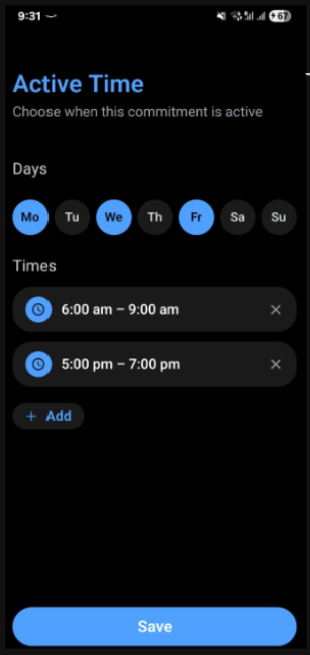
The user creates a rule:
```
Days: Monday, Wednesday, Friday
Time windows:
6:00 AM – 9:00 AM
5:00 PM – 7:00 PM
Timezone: Asia/Kolkata
Rule created on: Thursday, Jan 11, 2026 at 4:30 PM
```
Here's the critical point I stress:
**This data does not describe tasks. It describes availability rules.**
Nothing has happened yet. No task exists. This is just intent.
 **VITAL: One Rule = Multiple Atomic Tasks**
In our case, this single rule creates **6 separate tasks** — not one task with multiple conditions.
Why? Because each task must contain **only one time condition**.
This is critical for accountability:
* If a task fails, we know exactly which time slot failed
* If a waiver is used, we know exactly which slot it applies to
* If a penalty is applied, it's tied to a specific task, not a vague "rule"
Without this atomicity, the entire enforcement system becomes ambiguous.
```
Rule: Mon/Wed/Fri, 6-9 AM and 5-7 PM
↓
Creates 6 tasks:
Task 1: Monday 6-9 AM
Task 2: Monday 5-7 PM
Task 3: Wednesday 6-9 AM
Task 4: Wednesday 5-7 PM
Task 5: Friday 6-9 AM
Task 6: Friday 5-7 PM
```
Each task is independent. Each task can fail independently. Each task can be waived independently.
This is what makes tracking and enforcement possible.
***
## Step 2: User Clicks "Save" — What Should Happen?
Now I ask the obvious question out loud:
"When the user clicks Save, what am I actually supposed to do?"
My first answer was:
"Convert this into a task object with conditions."
So I showed how:
```typescript theme={null}
const task = {
id: "task_123",
userId: "user_456",
conditions: [
{
metric: "time",
relation: "within",
target: {
type: "range",
value: {
start_at: 1736592000, // Monday 6 AM
due_at: 1736602800 // Monday 9 AM
}
}
}
],
status: "active"
}
```
Time condition uses timestamps. Location condition uses geo. Other constraints attach as conditions.
And yes, I can assemble a valid task object from this.
At this stage, everything looks correct.
But then I pause and ask the next question.
***
## Step 3: Okay, This Works Once — But What About Recurring?
Here's the doubt I explicitly raise:
"If this is recurring, do I just:
* Schedule from Monday 6–9
* Wait till 9 AM
* Check evidence
* Then recreate the same task with next week's timestamp?"
And then I list the three trigger points I was thinking about:
1. Server restart
2. Recurring event end
3. User clicks Save
At this moment, the logic seems reasonable.
But this is where production thinking kicks in.
***
## Step 4: Where This Approach Becomes Dangerous
This is the critical realization, and I explain it very clearly.
I tell them:
"The danger here is not logic. The danger is idempotency and duplication."
Then I walk through failures.
### Problem 1: Server Crashes at 8:59 AM
```
Task exists
Evaluation job maybe ran, maybe not
Next task not created
System has no idea what it missed
```
### Problem 2: Server Crashes at 9:00:01 AM
```
Evaluation ran
Next task creation partially ran
Job retries
Now I might create duplicate tasks
```
### Problem 3: Server Restarts
And this is the killer question:
"How does the server know what recurring things even exist?"
Answer: it doesn't.
Because tasks don't explain why they exist.
***
## Step 5: Realization — This System Is Perfect For One-Time Tasks Only
This is where I explicitly correct myself.
I say:
"What I have right now is actually perfect for one-time logic."
User clicks Save → generate tasks for the next week → done.
But then I ask the uncomfortable question:
"How does the backend regenerate the same exact timestamps next week without the frontend helping again?"
The backend can't guess intent from tasks.
Tasks are already flattened output.
The intent is gone.
***
## Step 6: Key Insight — Intent Must Live Separately From Tasks
This is the turning point.
I explain it like this:
"The frontend knew how to convert intent into timestamps only because it still had the original rule."
So the backend needs that same capability.
That means:
* Rules must exist independently
* Tasks must be derived from rules
* Tasks must be disposable and recreatable
This is why we introduced the rules table.
***
## Step 7: Adding the Missing Piece — Persistent Rules
Now I show them the rules schema and explain why this single addition changes everything:
```typescript theme={null}
const rule = {
id: "rule_789",
userId: "user_456",
daysOfWeek: [1, 3, 5], // Monday, Wednesday, Friday
timeWindows: [
{ start: 360, end: 540 }, // 6 AM - 9 AM (minutes since day start)
{ start: 1020, end: 1140 } // 5 PM - 7 PM
],
timezone: "Asia/Kolkata",
active: true,
createdAt: 1736592600
}
```
The rule stores:
* Days of week
* Time windows
* Timezone
* Active flag
This becomes the source of truth.
Tasks no longer need to explain themselves. The rule already does.
***
## Step 8: Chain Scheduling Revisited (Now Done Correctly)
Now I go back to the original chain idea and reframe it:
### Earlier (Broken):
```
Task ends → create next task
No memory
No recovery
```
### Now (Correct):
```
Rule exists permanently
Chain scheduling only creates tasks from the rule
Each task is linked back to its rule
```
If something breaks:
I don't "fix tasks"
I re-derive tasks from the rule
That's the difference.
***
## Step 9: Why the Weekly Global Loop Is the Wrong Fix
I then address the question explicitly:
"Can I just run one loop per week for 10 million users?"
And the answer is no, because:
* It creates massive spikes
* It couples all users into one job
* Failures become global
* Scaling becomes painful
Avoiding infinite loops was correct instinct. Replacing them with a giant weekly loop was not.
***
## Final Conclusion (No Ambiguity)
This is the exact conclusion I state clearly:
**Chain scheduling + persistent rules = production-grade system**
The original chain system was dangerous because:
* It had no source of truth
* It relied on timing
* It couldn't recover safely
The moment we introduced rules:
* The system gained memory
* Tasks became regeneratable
* Crashes became survivable
* Duplication became detectable
At that point, the architecture stopped being "clever" and started being correct.
That's why this version is production-grade.
***
## Important Caveat
This is all mental process and reasoning.
The tougher challenges are still ahead:
* Android debugging and edge cases
* Timezone handling in real deployments
* Handling user modifications mid-series
* Detecting and recovering from duplicates
* Performance at scale
We've solved the architecture problem. Now we have to solve the implementation problem.
And that's where the real work begins.
***
## Honest Reflection
There's a satisfaction in getting the mental model right before writing code.
But I know from experience: the code will reveal problems the thinking didn't catch.
That's fine. That's how it works.
For now, the logic is sound. The next phase is making it survive reality.
**VITAL: One Rule = Multiple Atomic Tasks**
In our case, this single rule creates **6 separate tasks** — not one task with multiple conditions.
Why? Because each task must contain **only one time condition**.
This is critical for accountability:
* If a task fails, we know exactly which time slot failed
* If a waiver is used, we know exactly which slot it applies to
* If a penalty is applied, it's tied to a specific task, not a vague "rule"
Without this atomicity, the entire enforcement system becomes ambiguous.
```
Rule: Mon/Wed/Fri, 6-9 AM and 5-7 PM
↓
Creates 6 tasks:
Task 1: Monday 6-9 AM
Task 2: Monday 5-7 PM
Task 3: Wednesday 6-9 AM
Task 4: Wednesday 5-7 PM
Task 5: Friday 6-9 AM
Task 6: Friday 5-7 PM
```
Each task is independent. Each task can fail independently. Each task can be waived independently.
This is what makes tracking and enforcement possible.
***
## Step 2: User Clicks "Save" — What Should Happen?
Now I ask the obvious question out loud:
"When the user clicks Save, what am I actually supposed to do?"
My first answer was:
"Convert this into a task object with conditions."
So I showed how:
```typescript theme={null}
const task = {
id: "task_123",
userId: "user_456",
conditions: [
{
metric: "time",
relation: "within",
target: {
type: "range",
value: {
start_at: 1736592000, // Monday 6 AM
due_at: 1736602800 // Monday 9 AM
}
}
}
],
status: "active"
}
```
Time condition uses timestamps. Location condition uses geo. Other constraints attach as conditions.
And yes, I can assemble a valid task object from this.
At this stage, everything looks correct.
But then I pause and ask the next question.
***
## Step 3: Okay, This Works Once — But What About Recurring?
Here's the doubt I explicitly raise:
"If this is recurring, do I just:
* Schedule from Monday 6–9
* Wait till 9 AM
* Check evidence
* Then recreate the same task with next week's timestamp?"
And then I list the three trigger points I was thinking about:
1. Server restart
2. Recurring event end
3. User clicks Save
At this moment, the logic seems reasonable.
But this is where production thinking kicks in.
***
## Step 4: Where This Approach Becomes Dangerous
This is the critical realization, and I explain it very clearly.
I tell them:
"The danger here is not logic. The danger is idempotency and duplication."
Then I walk through failures.
### Problem 1: Server Crashes at 8:59 AM
```
Task exists
Evaluation job maybe ran, maybe not
Next task not created
System has no idea what it missed
```
### Problem 2: Server Crashes at 9:00:01 AM
```
Evaluation ran
Next task creation partially ran
Job retries
Now I might create duplicate tasks
```
### Problem 3: Server Restarts
And this is the killer question:
"How does the server know what recurring things even exist?"
Answer: it doesn't.
Because tasks don't explain why they exist.
***
## Step 5: Realization — This System Is Perfect For One-Time Tasks Only
This is where I explicitly correct myself.
I say:
"What I have right now is actually perfect for one-time logic."
User clicks Save → generate tasks for the next week → done.
But then I ask the uncomfortable question:
"How does the backend regenerate the same exact timestamps next week without the frontend helping again?"
The backend can't guess intent from tasks.
Tasks are already flattened output.
The intent is gone.
***
## Step 6: Key Insight — Intent Must Live Separately From Tasks
This is the turning point.
I explain it like this:
"The frontend knew how to convert intent into timestamps only because it still had the original rule."
So the backend needs that same capability.
That means:
* Rules must exist independently
* Tasks must be derived from rules
* Tasks must be disposable and recreatable
This is why we introduced the rules table.
***
## Step 7: Adding the Missing Piece — Persistent Rules
Now I show them the rules schema and explain why this single addition changes everything:
```typescript theme={null}
const rule = {
id: "rule_789",
userId: "user_456",
daysOfWeek: [1, 3, 5], // Monday, Wednesday, Friday
timeWindows: [
{ start: 360, end: 540 }, // 6 AM - 9 AM (minutes since day start)
{ start: 1020, end: 1140 } // 5 PM - 7 PM
],
timezone: "Asia/Kolkata",
active: true,
createdAt: 1736592600
}
```
The rule stores:
* Days of week
* Time windows
* Timezone
* Active flag
This becomes the source of truth.
Tasks no longer need to explain themselves. The rule already does.
***
## Step 8: Chain Scheduling Revisited (Now Done Correctly)
Now I go back to the original chain idea and reframe it:
### Earlier (Broken):
```
Task ends → create next task
No memory
No recovery
```
### Now (Correct):
```
Rule exists permanently
Chain scheduling only creates tasks from the rule
Each task is linked back to its rule
```
If something breaks:
I don't "fix tasks"
I re-derive tasks from the rule
That's the difference.
***
## Step 9: Why the Weekly Global Loop Is the Wrong Fix
I then address the question explicitly:
"Can I just run one loop per week for 10 million users?"
And the answer is no, because:
* It creates massive spikes
* It couples all users into one job
* Failures become global
* Scaling becomes painful
Avoiding infinite loops was correct instinct. Replacing them with a giant weekly loop was not.
***
## Final Conclusion (No Ambiguity)
This is the exact conclusion I state clearly:
**Chain scheduling + persistent rules = production-grade system**
The original chain system was dangerous because:
* It had no source of truth
* It relied on timing
* It couldn't recover safely
The moment we introduced rules:
* The system gained memory
* Tasks became regeneratable
* Crashes became survivable
* Duplication became detectable
At that point, the architecture stopped being "clever" and started being correct.
That's why this version is production-grade.
***
## Important Caveat
This is all mental process and reasoning.
The tougher challenges are still ahead:
* Android debugging and edge cases
* Timezone handling in real deployments
* Handling user modifications mid-series
* Detecting and recovering from duplicates
* Performance at scale
We've solved the architecture problem. Now we have to solve the implementation problem.
And that's where the real work begins.
***
## Honest Reflection
There's a satisfaction in getting the mental model right before writing code.
But I know from experience: the code will reveal problems the thinking didn't catch.
That's fine. That's how it works.
For now, the logic is sound. The next phase is making it survive reality.