

December 21st, 2025
The Day We Made the Right Call Today wasn’t a fallback day. It was a recovery day. A foundation day. A quiet progress day.Reality Check: Maps
Important
This was not a failure at maps. It was paused for the correct reason.What Actually Happened with Maps
- We fully explored Maps integration
- Tried react-native-maps
- Verified:
- SHA-1
- Package name
- APK signing
- SDK enabled
- Still hit billing + Visa card dependency
Correct Decision Taken
“Maps is blocked by infra, not by logic.”So we decided:
- Freeze Maps — pause development until infrastructure is ready
- Revisit once Visa card + billing is sorted
- Stop investing mental energy on something we cannot unlock today
What We Actually Built Today
Today was about Blocklist UI + structure. This is product-level work, not just UI polishing.Conceptually: What is Blocklist?
Blocklist =“When a commitment is active → restrict distractions.”
Types of blocks
- Apps
- Websites
- AI tools
UI Structure Designed
High-level layout
Data Flow
Tabs logic
- One
activeTab - One reusable
TabsBar - UI reacts purely to state
TabsBar Component
Tabs were not hardcoded. Instead:- Add “System”
- Add “Games”
- Add “Custom”
Search Bar Logic
Even if search isn’t fully wired yet:- The placement is correct
- The architecture accounts for:
- Filtering
- Inline typing
- Future debounce implementation
State Separation
State was kept separate:activeTabsearchTextinlineTextapps/webs/aiarrays
- State leaks
- UI glitches
- Impossible bugs later
Full Flow Diagram
Critical Evaluation
What Was Done Right
- Did not force Maps when infrastructure blocked it
- Shifted to high-leverage UI work
- Built reusable components
- Thought in systems, not individual screens
Key Insights
- Avoid equating productivity solely with infrastructure complexity
- UI and state design is real engineering work
- This blocklist will directly power:
- Discipline enforcement
- Value proposition
- Product differentiation
What This Unlocks Next
Because of today’s work, the next steps are clear:- Wire blocklist to native blockers
- Attach blocklist to commitment lifecycle
- Enforce blocks only during active windows
- Sync blocks via backend later
Final Assessment
Today was not a fallback day. It was:- A recovery day
- A foundation day
- A quiet progress day
Proof of Work
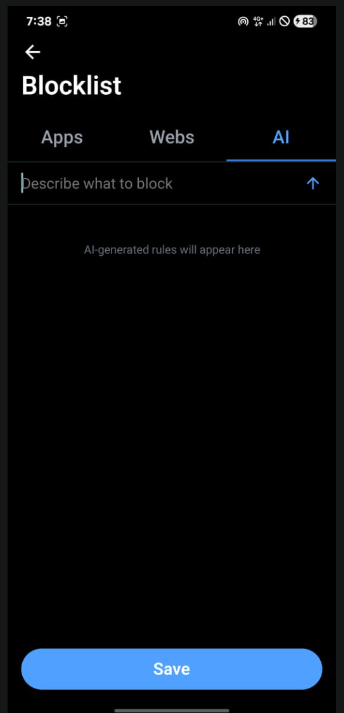
Blocklist UI structure - Apps, Webs, AI tabs with search